
Wilbraham Mountain and the Mystery of Whale Rock
One could only imagine what the early settlers of this area must have thought when they first came upon the massive stone boulder now known as Whale Rock, how it arrived there, and how long it had rested in the woods before it ever received a name. To them, it would have stood as something remarkable and unexplained, a silent reminder of forces far beyond human memory.
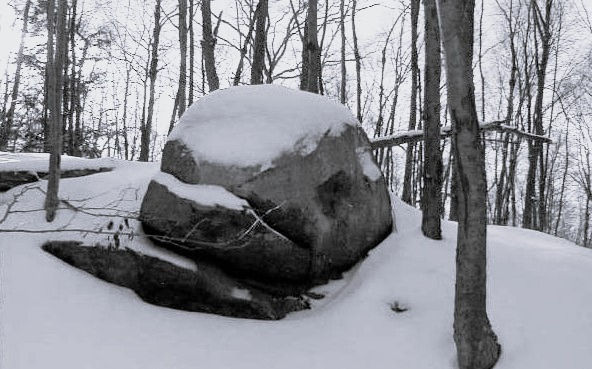
Wilbraham Mountain is part of the rolling highlands along the eastern edge of Wilbraham, a landscape shaped by ancient geologic forces and later carved by glaciers. While not a sharply defined mountain peak, the area is locally known for its wooded ridges, ledges, and rocky outcrops that rise above the surrounding valley.
The story of these hills begins nearly 200 million years ago, during a time when the Earth’s crust was pulling apart. As the continent of Pangaea began to rift, lava flowed into long cracks in the landscape and eventually cooled into hard basalt rock. Over millions of years, faulting and erosion tilted and exposed these formations, creating the ridge-and-valley terrain that is still visible in western and central Massachusetts today. Wilbraham sits on the eastern edge of this geological system, where the ridges are lower and more rounded, but still clearly tied to the same ancient origins.
Much later, during the last Ice Age, massive glaciers advanced across New England and reshaped the land once again. As the ice moved, it scoured bedrock, carved valleys, and carried enormous boulders long distances. When the glaciers finally retreated about 12,000 to 15,000 years ago, they left behind scattered rock formations known as glacial erratics.
One of these local features is known as Whale Rock. It is a large, naturally placed boulder whose curved shape resembles a whale rising from the water. Like many named rocks in New England, its identity comes not from formal designation, but from generations of local observation and storytelling. Early residents and later hikers used such landmarks for reference in the woods, and over time, the name “Whale Rock” became part of Wilbraham’s informal geographic heritage.
Together, Wilbraham Mountain and features like Whale Rock reflect both the deep geologic history of the region and the way residents have connected with the landscape over time, naming, sharing, and preserving its natural landmarks as part of the town’s living history.
Whale Rock can be seen along the Thayer Brook Trail, a local walking path that begins at the Wilbraham Community Gardens parking area. The kiosk marking the trailhead is located in the northeast corner of the gardens’ parking lot and serves as the starting point for the route.
From there, the trail is easy to follow. Hikers proceed from the kiosk and continue along the marked path until reaching a stone wall opening, where the route passes straight through. Continuing along the trail leads into the wooded landscape where Whale Rock can be found.



Comments