
Wilbraham: Center and North Village Before the early 1900s
- Dec 18, 2025
- 4 min read
Wilbraham has long been a town of distinct neighborhoods, each with its own character and traditions. While many localities developed familiar names and small institutions of their own, only two areas achieved full recognition as villages with commercial activity and post offices: Wilbraham and North Wilbraham. These two villages, located about two miles apart, are connected by what has long been regarded as one of the most pleasant and scenic roads in Hampden County.
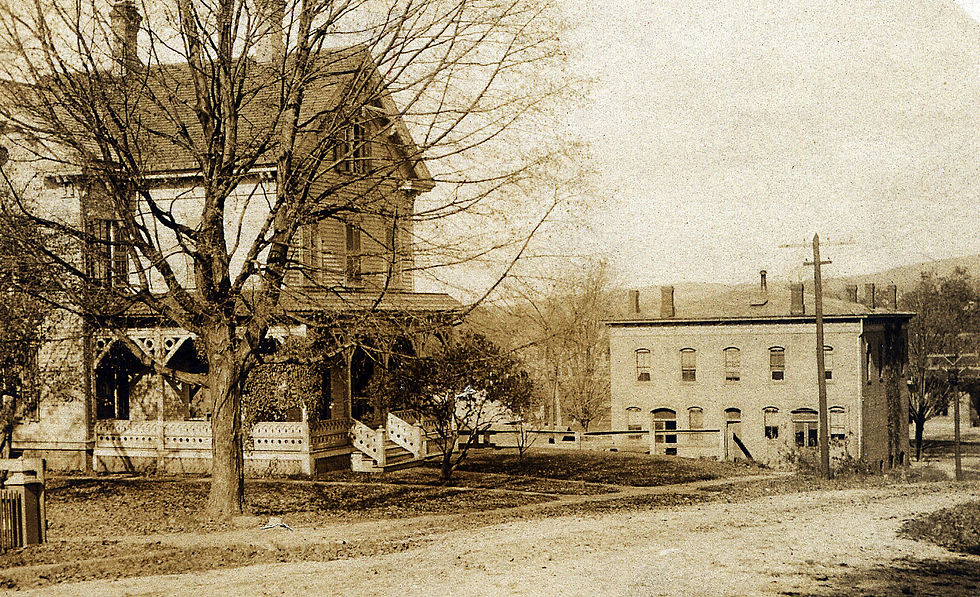
The village of Wilbraham, formerly known simply as “the Centre,” was the earliest settled part of the town. Its history reaches back more than 250 years to the time of the town’s first pioneers. Despite being home to Wesleyan Academy, one of the most respected educational institutions in the county, the permanent population of the village itself never exceeded about 450 residents. The academy played a crucial role in sustaining Wilbraham as a commercial center. North Wilbraham, with its railroad connections, eventually surpassed the older village in trade and activity.

For many years, Wilbraham supported at least one well-established general store. Among the early merchants were Roderick Burt, Robert R. Wright, and George W. Ely. Later merchants included George W. Ely, Frank A. Gurney, and Charles N. Mowry. A post office was established in Wilbraham in 1821, with William Knight serving as the first postmaster. In later years, Frank A. Gurney held that position.

North Wilbraham developed along the railroad line of the Boston & Albany Railroad and became both a post office and a way station. Its commercial importance was closely shared with the nearby station known as Collins, located in Ludlow on the Athol Branch Railroad. In fact, the northern part of town was often associated with the Collins family, particularly Warren Collins and his relatives, who played a prominent role in Wilbraham’s history for more than half a century. The Collins store, one of the largest country stores in Hampden County, was a central feature of the village until it was destroyed by fire in the fall of 1900.
Before becoming known as North Wilbraham, this section of town was informally called “Sodom.” Around 1846 or 1847, when a post office was established, the name North Wilbraham came into general use. Warren Collins was appointed postmaster and served until 1878. In later years, the office was held by John W. Baldwin. Merchants in North Wilbraham included Frank A. Fuller, a general dealer, and James Egan, a druggist.
Before 1865, Wilbraham was not widely known as a manufacturing town, though several early industries operated within its borders. These included gristmills, sawmills, carding and fulling mills that produced cloth mainly for local use, and a tannery owned by Thomas and Henry Howard. Abraham Avery also operated a small tanning business at one time.
In the northern part of town, industrial activity developed more fully. At Butlerville, located about a mile east of North Wilbraham, Benjamin Butler once operated a sawmill for Dr. Marcus Shearer, giving the area its name. The Ellis Mills later occupied the site and were active around 1868. Dwight W. and Stillman Ellis were leading figures in this enterprise, which produced cassimeres and employed a substantial workforce. The firm of Gates & Nelson was also associated with manufacturing in this area.
One of the most significant industrial concerns in Wilbraham’s history was the Collins Manufacturing Company. Originally incorporated in 1872 as the Collins Paper Company with a capital of $200,000, much of it drawn from Amherst College funds, the company was reorganized in 1876 under its later name, with capital increased to $300,000. Despite changes in ownership and management over the years, the company remained in continuous operation and became the principal industrial enterprise in eastern Hampden County. Eventually, the plant became part of the Whiting system of paper manufacturing interests.

Another important manufacturing operation in North Wilbraham was the Cutler Mills. Beginning operations in early 1877, the mill processed ground feed and grain with a capacity of ten carloads per day and continued in steady operation for decades.
Wilbraham earned a reputation as one of the most solid and reliable towns in Hampden County. From its hills and farms came men who played important roles in public service, both locally and at the state level. Among those remembered in town history are Abel Bliss, once a candidate for lieutenant governor on the abolition ticket; Deacon and Captain Moses Burt, active in both civic and church affairs; John M. Merrick, a respected farmer and justice of the peace; Samuel Merrick and Roderick S. Merrick, both prominent in agriculture, church life, and public service; and Roderick Burt, a long-time merchant.
Robert R. Wright served as a merchant in Wilbraham for nearly forty years, while his son, Robert R. Wright Jr., moved west in 1872 and later became mayor of Denver, Colorado. Physicians such as Dr. Luther Brewer, Dr. Gideon Kibbe, and Dr. Jesse W. Rice were influential figures in town life, as were farmers and community leaders, including Deacon Horace Clark, Joel M. Lyman, Timothy Brewer, John Bliss, and Solomon Wright. In North Wilbraham, John Baldwin and Warren Collins were especially well known, as was W. Levi Collins, a prominent merchant and businessman.
By the early twentieth century, Wilbraham continued to be guided by capable town officers and business leaders. The selectmen, Jason Butler, Henry Clark, and Fred W. Green, also served as overseers of the poor and members of the board of health. Other town officials included Frank A. Fuller, town clerk and treasurer; Frank A. Gurney, auditor; Walter M. Green, tax collector; and several assessors, trustees, and justices of the peace who carried on the daily work of town government.
Local commerce and professional life were supported by merchants, coal dealers, physicians, mill superintendents, farmers, and tradesmen whose combined efforts shaped Wilbraham’s identity. Together, these men and women, named and unnamed, formed the backbone of a town that balanced tradition, industry, and civic responsibility, securing Wilbraham’s place as one of Hampden County’s most enduring communities.


Comments