
The South Wilbraham Academy
- Dec 15, 2025
- 3 min read
Updated: Feb 9
In the years following 1840, concern grew among some residents of South Wilbraham that the education provided by the town schools was no longer sufficient for students seeking advanced instruction. At the urging of the local minister, several prominent citizens took up the question, and a committee was formed to explore the establishment of a higher-level school. Their efforts resulted in the creation of the South Wilbraham Education Society, which was in operation by 1844.
The early classes were held in modest quarters, but enrollment steadily increased. By about 1850, it became clear that a permanent building dedicated to academic instruction was needed. Shares were sold to support the project, and construction of a new academy building took place between 1850 and 1852. A surviving prospectus from 1852 outlines the curriculum, tuition rates, and available boarding arrangements. The completed structure, built in the Greek Revival style, remains a fine local example of that architectural tradition.
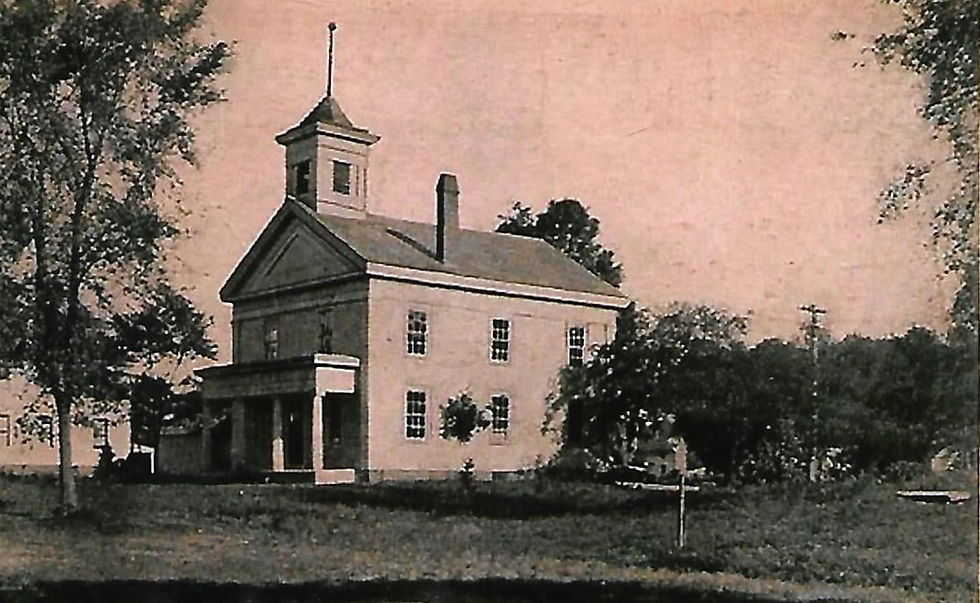
George Brooks served as the academy’s first principal, followed over the years by several other instructors, including Howe, Marsh, Warner, Bliss, and Alonzo B. Newell, who was the final teacher. With occasional interruptions, the academy operated for three to four decades and at times enrolled forty or more students. Contemporary historians took note of its quality, describing it as a school of recognized academic merit, sustained through private support and community involvement.
Beyond its educational purpose, the academy building quickly became a center of community life. Records show it was used for concerts, square dances, lectures, and other public gatherings, including performances by Jubilee Singers and even a meeting associated with the Kickapoo Native Americans. In 1874, Father Lynch conducted Catholic services in the hall. When the Center School burned in 1913, classes were temporarily held in the academy building.
The structure continued to serve the town in many important ways. During World War I, Red Cross meetings were held there in 1917 and 1918. From 1920 to 1932, the Hampden Public Library occupied the building, with Hazel Burleigh serving as librarian. Town meetings were also held there for many years, with the town paying annual rent, until a new Town House was donated in 1932 by Miss Elizabeth Sessions.
Although the town considered purchasing the academy building as early as 1899, no action was taken at that time. In 1910, the town invested $978.63 in refurbishments, despite not owning the property. The building was finally acquired by the town at auction in 1934. Since then, it has continued to host meetings and activities for organizations such as the P.T.A., Young Men’s Club, V.F.W., Civil Defense, and the Boy Scouts.
For more than a century, the South Wilbraham Academy has served as an important center for education, civic activity, and community life. Today, the building is home to the Hampden Historical Society, a nonprofit organization devoted to preserving and sharing the history of Hampden, Massachusetts.
Founded in 1961, the Society was established to collect and safeguard historical artifacts and documents, encourage an understanding and appreciation of the town’s past, and provide educational and cultural opportunities for the public. Over the years, it has assembled a substantial collection of books, photographs, and artifacts that document Hampden’s history.
The Society maintains a research library and museum within the former academy building, offering valuable resources for historians, students, and residents. It also promotes public interest in local history through lectures, exhibits, and special programs, continuing the building’s long tradition as a place of learning and community engagement.


Comments