
The Old Turnpike Gate of Wilbraham
- Dec 12, 2025
- 2 min read
Long ago, travelers along Boston Road would encounter a small but notable landmark: a toll gate perched on the hill east of Twelve Mile Brook, roughly seventy feet west of where Crane Hill Road now lies. Likely established around 1798, the gate served as a checkpoint for passing wagons and teams until it was discontinued around 1847.
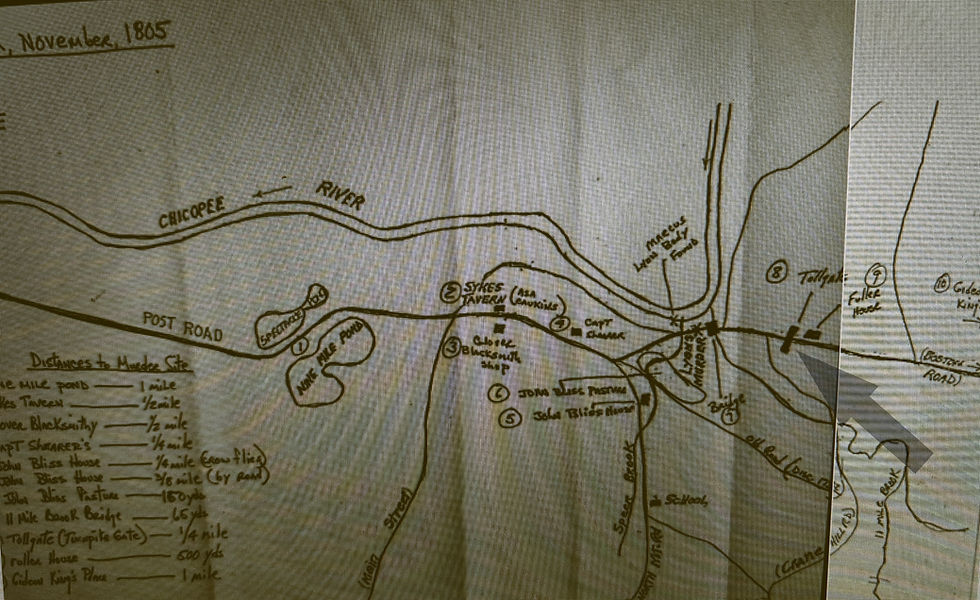
Wilbraham holds a unique place in Massachusetts history, having been crossed by both the first and the most recent turnpikes built in the Commonwealth. The earliest toll road in town dates to the late 18th century. In 1796, a charter was granted to improve the County Road from Warren to Palmer, and two years later, the route was extended to reach North Wilbraham.
One of the project’s most remarkable features was a half-mile-long excavation along the Chicopee River, locally known as the “Dugway.” This stretch became part of what is now Boston Road (Route 20). Operated by a private corporation, the toll road remained in service until about 1847.
During its operation, a toll house stood at the base of Butler Hill, just west of today’s Crane Hill Road. Some travelers avoided paying the toll by using a “shunpike”, a bypass route that branched near present-day Three Rivers Road, opposite Circle Drive, and rejoined the County Road just west of the toll house.
For several years, beginning in 1831, Adna Bishop served as gatekeeper. He lived nearby on the north side of the road, close to a barn that eventually fell into ruin. Interestingly, the barn had its own unusual history: it was originally built in Holyoke, dismantled, transported on sleds during winter, and reassembled at the Bishop property to serve a new purpose.
The memory of the toll gate lived on through generations. One of Adna Bishop’s daughters married Albert Bliss and shared stories of the gate with her son, Ethelbert Bliss. Rev. Charles H. Gates, who celebrated his ninety-first birthday last March, recalled spending his boyhood nearby and remembered the gate’s exact location. Henry M. Bliss also recalled that the toll for a single team was “fo-pence, ha-penny”, about nine cents.
Rev. Gates captured the experience in verse, giving us a vivid glimpse into daily life at the turnpike:
"The Old Turnpike Gate,Long have I stood there to waitFor change, in rainstorm or snow.Gladly felt I to see it go."
Though the gate is long gone, its story endures, a small window into the daily life of early travelers and the people who kept the roads of Wilbraham moving.


Comments