
The Moodus Drum and Fife Corps at Wilbraham
- Dec 16, 2025
- 2 min read
These photographs are believed to have been taken on June 18, 1913, during the second day of events marking Wilbraham’s 150th anniversary. The images were captured at the Collins Inn in North Wilbraham, a gathering place well suited to such a regional celebration. Among those present were members of the Moodus Drum and Fife Corps, whose appearance reflected a tradition already nearly a century old.
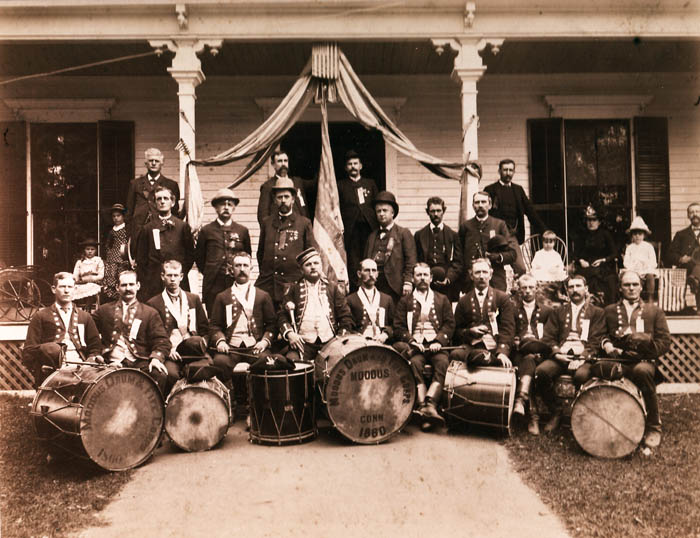
The story of the Moodus Drum and Fife Corps begins in 1821 in the small mill village of Moodus, Connecticut. It was a community shaped by hard work, close ties, and long-standing customs. Music was already worked into daily life, but a distinctive drumming tradition emerged under the influence of Hezekiah Percival. Drawing on early American martial practices, Percival taught local men to play with open sticks, using strong, deliberate strokes designed to project sound over long distances. This was not refined or ornamental music, but functional, powerful, and firmly rooted in early American tradition.
The instruments themselves were central to that tradition. Many of the drums were made in the early nineteenth century by Eli Brown. Constructed of wood and tensioned with rope, these drums were built for durability and volume. Passed down through generations, they remained in use for decades, their worn shells and drumheads bearing the physical evidence of countless marches, musters, and public occasions.
As the nation entered the Civil War era, the Moodus drummers occupied an important place in community life. When local men departed for military service, the Corps often provided music for farewells and public gatherings. Though not a military unit, the drummers supplied familiar rhythms and patriotic tunes that connected those leaving home with the communities they represented.
By the late nineteenth century, the Moodus Drum and Fife Corps had earned a reputation well beyond their home village. They performed throughout New England and at major public events, including the dedication of the Bennington Battle Monument in 1891. Their audiences included prominent public figures, yet the Corps remained committed to its established style. Their performances continued to emphasize volume, precision, and adherence to older playing methods.

Moodus became a model for other drum and fife corps. Groups seeking to preserve early American musical traditions looked to their repertoire and technique for guidance. While drumming styles evolved elsewhere, the Moodus Corps deliberately maintained what they regarded as the “ancient” style, believing that historical sound was an essential part of historical memory.
That tradition continues today. The Corps still performs at public events and gatherings such as the annual Thunder in the Valley, where drums and fifes once again echo through the landscape. New generations learn directly from experienced players, sustaining a musical lineage that reaches back more than two centuries and ensuring that this distinctive sound remains a living part of New England’s cultural history.


Comments