
Rooted in History, Crafted by Joe Mell
Updated: 8 hours ago
Around 1734, before Wilbraham's incorporation in 1763, the Outward Common remained a sparsely settled landscape of rough paths, scattered clearings, and newly established homesteads. It was during this early period that Deacon Nathaniel Warriner established his home along what would later become the West Road (now Main Street). He was the fourth settler in that section of town, selecting a level and fertile tract that provided both practical farmland and a clear vantage along the roadway.
Like many early New England settlers, Warriner worked with the land rather than trying to remake it. At the south side of his homestead, a great elm likely stood, deliberately spared as the surrounding forest was cleared. Such trees were often left in place during the colonial period not by chance, but by design. They offered shade, marked the location of a dwelling, and lent a sense of stability and endurance to a landscape still in transition.
The later elm that grew on this site, formed from three saplings that gradually fused into a single trunk, suggests a quiet continuity. Whether sprung from the roots or seeds of that earlier tree, it stands as a living successor, carrying forward the presence of the original elm and deepening the sense of connection between past and present.
Warriner built his home near this tree and, in time, operated a tavern there. In the mid-18th century, taverns were essential institutions, particularly along developing roads. They served not only as places of refreshment and lodging but also as centers for communication, business, and civic life. Warriner’s tavern became an important stopping place for travelers moving through the region.
The elm stood at the center of this activity. Its broad canopy shaded the yard where horses were tied and wagons assembled. Travelers gathered beneath its branches before entering the tavern, exchanging news or tending to their equipment. In this way, the tree functioned as both a physical and social focal point, an informal meeting place as significant as the tavern itself.
On June 24, 1741, a notable event occurred nearby with the organization of Wilbraham’s first church. The ordination council had initially planned to convene outdoors beneath a large oak tree at the home of Daniel Warner, just up the road, where a simple pulpit and log seating had been arranged. However, when a sudden storm arose, the gathering was forced indoors to Nathaniel Warriner’s barn, where the ordination services were ultimately completed.
By the time of the American Revolution, the West Road had become a well-traveled route, and Warriner’s tavern remained an active and important stop. On April 20, 1775, the day following the battles of Lexington and Concord, word of the fighting spread rapidly through the countryside. Samuel Glover rode along the road, alerting residents and calling them to arms. Captain Noah Warriner responded by assembling local minutemen, while warnings echoed from homestead to homestead across the Outward Common.
In November of 1778, the same road carried a very different procession. The defeated army of British General John Burgoyne, known as the Convention Army, was marched south through Massachusetts. On November 7, approximately 4,000 troops, along with baggage wagons and members of officers’ families, including General Friedrich Riedesel, passed through Wilbraham. Originally intended for transport through Springfield, the army had been redirected south to prevent its proximity to the Springfield Armory. The column moved along the West Road, likely encamping briefly before continuing through Enfield, across the Connecticut River into Suffield, and ultimately toward Virginia. The elm stood as a silent witness to the passage of this once-formidable force.
Less than a decade later, in 1787, the unrest of Shays’ Rebellion again brought activity to Warriner’s tavern. Several of Daniel Shays’s followers are believed to have lodged there before marching toward the Springfield Armory. Once more, the elm bore witness as men passed beneath its branches on their way to a pivotal moment in Massachusetts history.
The years that followed reflected both the ordinary and the tragic events of community life. On May 2, 1799, a funeral procession passed by for five of six young people who had drowned in Nine Mile Pond. Two weeks later, on May 16, another funeral was held for Abigail Merrick. Through these moments of sorrow and remembrance, the elm remained a constant presence.
Over time, the original elm declined, as many elms eventually did due to age and environmental factors. Yet elms were among the most valued trees in colonial New England. Frequently planted or intentionally preserved, they shaded homes, lined roads, and marked important sites such as taverns, meetinghouses, and farms. Their presence often signified stability and long-standing settlement.
From the seeds of the original tree, new growth emerged. By the mid-19th century, three saplings had taken root near the site of the earlier elm. As they matured, their trunks grew together in a natural process known as inosculation, eventually forming a single, unified tree. This fused structure created a striking and enduring landmark.
When the tree was examined in 2023, growth-ring analysis indicated an age of approximately 170 years, placing its origin in the mid-1800s. While it was not the same tree that shaded Deacon Warriner’s tavern, it stood as a direct successor, a second-generation elm rooted in the same ground and carrying forward the legacy of its predecessor. Its intertwined trunk symbolized both resilience and continuity, linking generations of residents to the earliest days of Wilbraham’s settlement.
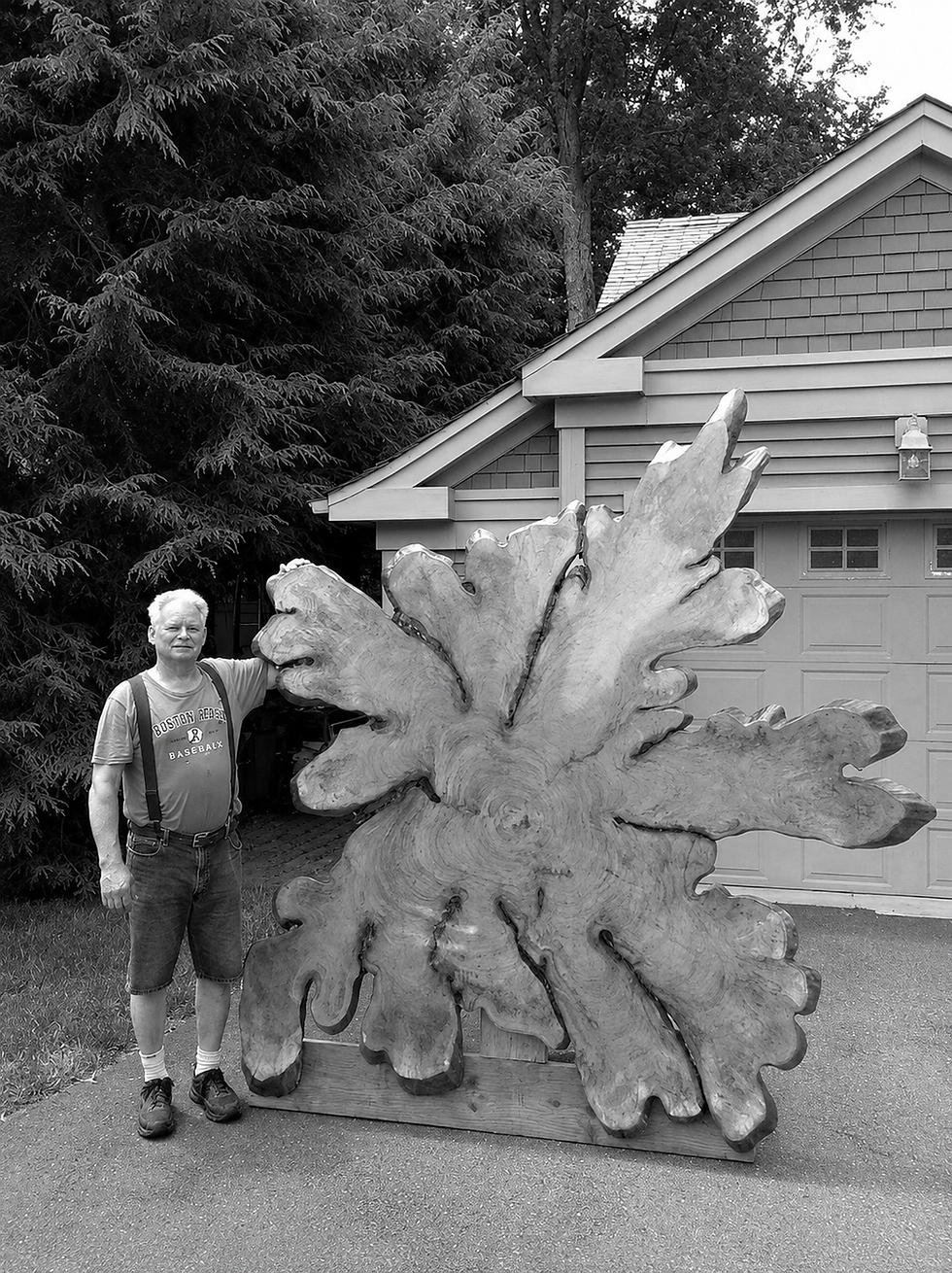
Today, a portion of this second-generation elm has been preserved. Master craftsman and woodworker Joe Mell has three slabs from the base, carefully cut and dried. But how did Joe come to possess a piece of this remarkable Wilbraham landmark? That is where the story unfolds.
A local contractor purchased the house and property where the elm stood. At the time, it was still alive. Because it was considered a historic tree, it could not be cut down, even though it was in poor condition. Its location also made the lot unbuildable. Some time later, it finally died. As one old-timer put it, “The tree died of abandonment with the Bennett Family moving away.”
The lot was eventually sold to Joe’s friend. By then, the dead tree posed a danger and could be removed. A local tree company was hired to take on the difficult task.
Its size was remarkable. The main trunk measured approximately 21 feet in circumference, making it about 7 feet in diameter. It stood approximately 12 feet tall before branching out. As the crew worked their way through the enormous trunk, they encountered metal on nearly every cut: barbed wire, nails, and even a horseshoe deep inside that had apparently hung on it for an estimated 100 years.
Once it was cut down, the wood was divided. The tree itself was given to a local person, while the massive stump was given to Joe. He now faced another challenge: finding someone capable of cutting the stump into slabs and transporting them to his workshop, where he could begin preserving this piece of Wilbraham’s past.
Joe remembers standing in front of the stump with his friend Kurt Piper, a premier woodworker who has worked with wood his entire life. The two men stood there quietly, marveling at what lay before them.
Finally, Joe broke the silence.
“No matter what, I was going to harvest that piece and preserve it for all to see.”
Kurt responded, “A true woodworker has to have the ability to visualize in his mind what could be created, to see beyond what the average person sees.”
Those words gave Joe the encouragement he needed to move forward.
The J-Team from South Deerfield was the company capable of taking on the job. Two brothers with remarkable chainsaw skills approached the stump almost as a surgeon would approach an operation, with precision and control. Their “scalpel” was a chainsaw equipped with a 59-inch bar, which they used to make an almost perfectly flat, freehand cut across the base, nearly 13 feet wide. It was an extraordinary feat.
Once the stump arrived at Joe’s shop, he brought the J-Team back to cut it into three slabs. Of the three, Joe chose to finish the top piece because it had the most symmetrical shape. The larger slabs were bigger but had more irregular shapes. The largest measured 13 feet, 10 inches long and 6 inches thick.
Flattening the slab presented another challenge. Joe built a 20-foot router sled and milled the wood while it was still green. As it dried, the slab split into five separate pieces. Joe placed them in his garage, where they continued to dry for five years. During that time, they warped and twisted.
His goal remained the same: to reassemble the pieces so they would resemble what he had first seen.
Accomplishing that required an enormous amount of time, patience, and craftsmanship. Joe carefully traced each section and created a template before using specialty glue to reassemble the wood. He made approximately 70 bow-tie joints and embedded steel and aluminum rods to provide additional structural reinforcement. Each step was necessary to carefully piece the sections back together as they had originally been.
The work was especially challenging because elm is notorious for cupping and warping due to its interlocking grain.
Handling a slab of this size required Joe to build a special rolling table. He could roll it out onto his driveway, giving him plenty of room to work. When it was necessary to work on the opposite side, three or four people were required to help flip it over.
Perhaps the most important step was sealing the finished piece. Joe hand-rubbed tung oil into the wood, applying seven coats to each side. The natural finish brought out striking areas of what is known as “flame grain.” This effect is caused by the immense weight of the tree and makes the grain appear almost as if it were on fire.
For Joe Mell, this was much more than a woodworking project. It was an opportunity to preserve a tangible piece of Wilbraham’s past, a landmark that had stood for generations and witnessed the changing community around it.
In talking with Joe, it is clear how proud he is to have completed this project. He not only preserved a remarkable piece of local history; through his craftsmanship, he feels he has become a small part of its story.


Comments